



ImmunoX Eco Seminars
Overview
Each week during the school year, we and other institutions invite speakers to fly to us and spend a day interacting, presenting a seminar, sharing data and ideas. This, however, has an enormous carbon footprint and also takes nearly 2 days of time by each speaker to travel.
ImmunoX Eco Seminars take advantage of improved Tcon capabilities to have distant seminar speakers attend 'virtually' and thereby save a shedload of greenhouse emissions. As a bonus, it represents a physically easier visit for well-traveled speakers. Although such a meeting will always be somewhat lesser than 'real-life' for physical interactions, we are working on details to make these visits 'better' in other respects. A second variant of the EcoSeminar invites speakers to travel and stay longer, taking ‘Mini Sabbaticals’ and making the most of the carbon expenditure for the travel. 1:1 meetings can be spread over more time, can recur as ideas percolate during the stay and speakers can use the time to work on writing projects, come to lab meetings with putative collaborators, and even Zoom back to meetings as needed. We provide the office!
Eco Seminar Protocol
Eco Seminar is committed to good science and are anxious to do our part to reduce carbon emissions. With just 50% participation, we could save upwards of 15 tons of carbon from the atmosphere per year with this initiative alone. (1 ton is one person-year in most of the world).
A large value of invited seminars are to 'mix' our science, seeing perspectives of those outside of our geographic terrain. Often speakers convey their special way of seeing the state of the field, in addition to presenting their take on their studies, whether published or unpublished. Their visits also provide a venue for us to present our newest ideas/studies to them throughout the day. Finally, the seminar itself provides a venue for our community to come together, getting us all in the room together (and en route to/from) so we interact.
We accept that an Eco seminar will be 'different' from a conventional one. Adaptation means different, but it is not necessary to lose these key elements. Indeed some elements of an Eco visit can be better than in person, for example because members of the visitors lab can join in lab-to-lab meetings.
- We use a Zoom link between a visitor's office and our conference room, supplemented with an Owl (https://www.owllabs.com/meeting-owl). As a backup, we ask the speaker to pre-record their talk to prevent any technical issues from arising during the seminar.
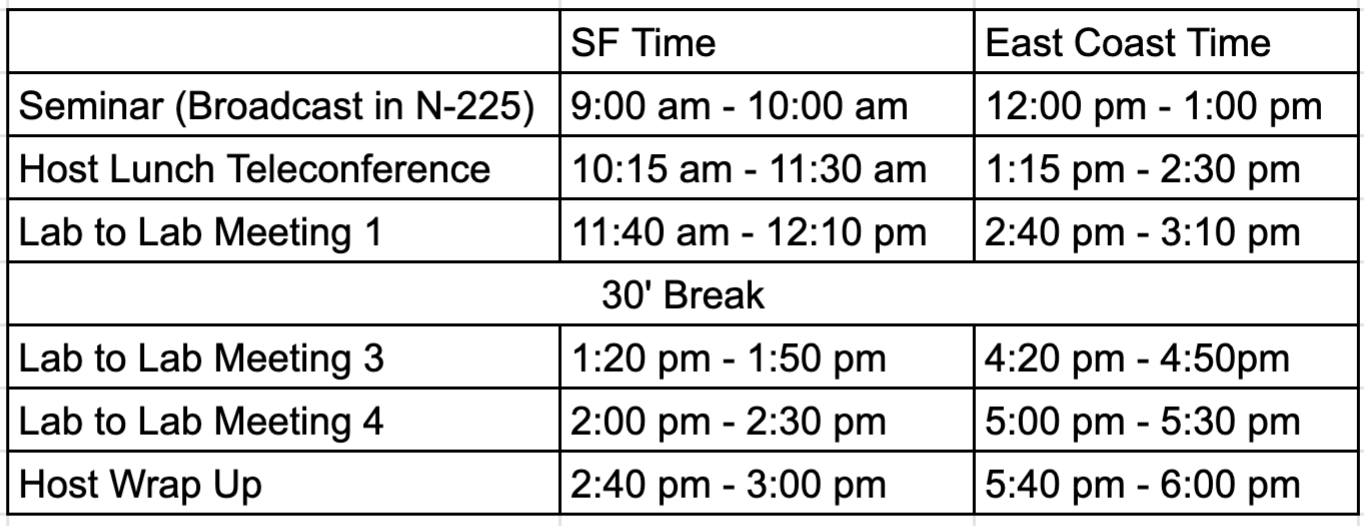
- A typical agenda for a visitor from the East coast looks like:
- To encourage our people to attend and thus maintain a vibrant seminar environment, we provide a "Super Breakfast" in the seminar room. This helps to maintain the role of ImmunoX seminar as a 'meeting place' for us, with ourselves, and thereby also guarantee guests to get great exposure for their science. Note, as part of this being Eco, we are not buying food with meat which saves as much or more greenhouse gas as the airplane flight.
- If the seminar is pre-recorded, during the seminar, we host a live-chat session with the speaker and his/her lab to ask questions, seek further follow up etc.
- The format for the host event is typically 5-10' introduction and questions about the seminar, 30' minute presentation by the UCSF host lab, 30' discussion and/or presentation by visitor lab members sand 10 minutes wrap up/action items.
- Collaborations actually happen when postdocs and students are part of the discussion. Eco visits allow the speaker's postdocs to join whereas they never get to join when just speaker visits UCSF on their own. To facilitate getting the right people together, when ImmunoX schedules the lab to lab meetings, each lab that wishes to meet with the speaker provides:
- The name of postdoc(s) or student(s) who will join this meeting and present their work.
- A title and a few sentence abstract of the science they will share. The 'visitor' can use this to invite their own postdocs/students to join as well.
- These are provided as part of the 'visiting' schedule at least 2 days in advance
- A virtual visit does not need to 'fill' a day and slots can be removed. Conversely, additional ones can be added lab-to-lab meetings can be added if the speaker agrees.
- Speakers receive an honorarium, equivalent to an in-person visit.
Mini-sabbatical
Similar to our Eco-Seminar, we also encourage visitors to consider our Mini-sabbatical seminar option. For this plan, we hope to ensure that, if a guest does make the trip to the Bay Area, the impact of the stay is maximized by extending the visit time. Visitors would plan a multi-day stay during which they would have more intimate collaboration visits with ImmunoX’s various immunology labs. Note, a limited number invited speakers can be accommodated under this new piloted program.
- The specific duration is to be decided on a case-by-case basis, though templated duration is 14 days.
- ImmunoX will coordinate with the visitor and/or their administrative assistant to schedule meetings with UCSF faculty and trainees, and to provide opportunities to participate in UCSF scientific events.
- During this period, an office space would be secured at Parnassus Heights to allow the visitor to Zoom back and forth with their prior commitments as needed.
- Visitors would secure their own lodging (per their preference of hotel or homestay; recommendations available) and be reimbursed for the lodging by UCSF (maximum expense determined by UCSF overnight policy, currently $275/night).
- Visitors would secure their own airfare and be reimbursed by UCSF (following coach/economy flight restrictions of the university).
- Visitors would be responsible for their own meal expenses.
- A requirement of this seminar type is that the guest would need co-confirmation by an ImmunoX faculty member host.